
Loading
Preparing for you…

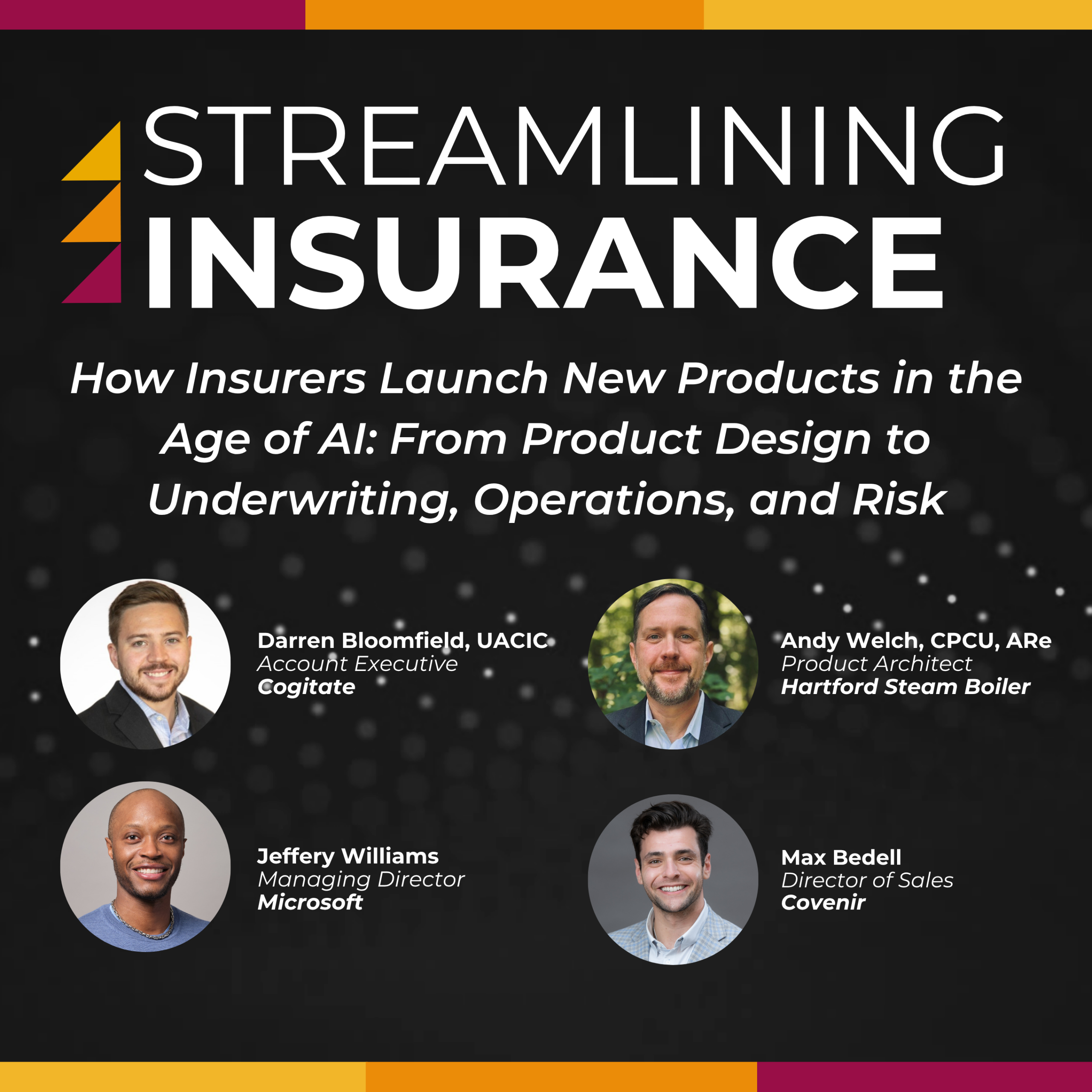
Streamlining Insurance: How Insurers Launch New Products in the Age of AI – From Product Design to Underwriting, Operations, and Risk

LinkedIn
Facebook
Twitter
Email

Artificial intelligence (AI) is rapidly transforming the insurance industry, creating new opportunities for efficiency, innovation, and growth. But while conversations about AI often focus on automation, a recent Alliance Insights discussion revealed a more important theme for insurance professionals: AI works best when it enhances human expertise, not replaces it.

In this episode Andy Welch, CPCU, ARe from HSB , Jeffery Williams from Microsoft, and Max Bedell from Covenir gathered to discuss the future of AI in insurance, covering topics ranging from AI liability insurance and emerging risks to insurance operations, underwriting workflows, and customer experience. Their insights provide a valuable roadmap for carriers, MGAs, agencies, and insurance professionals seeking to navigate an increasingly AI-driven marketplace.

Watch or Listen:

AI Is Creating New Insurance Risks

One of the most significant developments discussed was the emergence of AI liability exposures.

As organizations adopt generative AI, autonomous systems, and AI-powered decision-making tools, insurers are beginning to evaluate how traditional policies respond to AI-related losses. According to HSB’s Andy Welch, some carriers have already begun introducing exclusions designed to address AI-generated risks, particularly on the general liability side.

This evolution creates both challenges and opportunities. Just as cyber insurance emerged to address new technology-related exposures decades ago, many industry experts believe AI liability coverage may follow a similar path.

For insurance professionals, understanding these evolving risks will become increasingly important as businesses expand their use of AI technologies across operations, customer service, product development, and decision-making.

AI Is Changing How Insurance Work Gets Done

While AI is creating new risks to insure, it is also changing how insurance organizations operate.

From underwriting and claims to customer service and policy administration, insurers are exploring ways to use AI to streamline repetitive tasks and improve productivity. Microsoft’s Jeffrey Williams highlighted one of the biggest advantages of AI: it enables professionals to spend less time on administrative activities and more time solving problems, building relationships, and serving customers.

This shift is particularly valuable in an industry where expertise and judgment remain essential. AI can help summarize information, analyze large volumes of data, and surface insights quickly, but experienced professionals are still needed to evaluate risks, make decisions, and communicate with clients.

In other words, AI is becoming a powerful assistant—not a replacement for insurance expertise.

Insurance Will Always Be a People Business

Despite advances in automation, the panel repeatedly emphasized that insurance remains a relationship-driven industry.

Whether helping a client through a claim, advising on coverage needs, or managing a complex underwriting decision, human interaction remains central to the customer experience. AI can make these interactions more efficient, but it cannot replace trust, empathy, and professional judgment.

As one panelist noted, some of the most important customer interactions occur during moments of uncertainty—such as a claim or billing issue. These are opportunities for meaningful engagement, not simply transactions to automate.

For agencies, carriers, and MGAs, the goal should be to use AI to support employees and improve service, not eliminate the personal connections that differentiate great insurance organizations.

The Competitive Advantage Will Be Adoption

The discussion also explored what will separate successful insurers from their competitors over the next three to five years.

The answer wasn’t simply access to better technology. Instead, success will belong to organizations that help employees effectively adopt and leverage AI capabilities.

Companies that invest in training, develop thoughtful AI strategies, and identify high-impact use cases will gain a significant advantage. AI initiatives that focus on improving employee effectiveness and enhancing customer experiences are more likely to deliver meaningful business results than implementations driven solely by automation goals.

The organizations that thrive will be those that view AI as a strategic business capability rather than just another technology project.

Looking Ahead

The insurance industry has a long history of adapting to emerging risks and technological disruption. From equipment breakdown coverage to cyber insurance, insurers have consistently evolved to address changing customer needs.

Artificial intelligence represents the next chapter in that evolution.

As AI continues to influence risk management, underwriting, claims, operations, and customer engagement, insurance professionals have an opportunity to lead rather than react. By embracing AI thoughtfully and maintaining a focus on people, the industry can unlock greater efficiency while preserving the expertise and relationships that define its value.

Learn More About Insurance Company Operations

Want a deeper understanding of how insurance companies operate and adapt to industry change?

The CIC Insurance Company Operations course from the Risk & Insurance Education Alliance explores insurance company structure, underwriting operations, claims management, technology, financial performance, and strategic decision-making. Gain practical insights into how today’s insurance organizations function and how innovation is shaping the future of the industry.

Explore CIC Insurance Company Operations and build a stronger understanding of the business behind insurance.

Andy Welch, CPCU, ARe is a Product Architect on HSB’s Innovation and Customer Experience team, where he is responsible for new product development, product enhancements, and validating new business models and channels for existing solutions. Before assuming his current role, Andy worked as a Commercial Lines Underwriter, and also as a Product Owner for two major insurance carriers. Andy has a Bachelor of Fine Arts degree in Creative Writing from Vermont State University.

Jeffery Williams is a Managing Director and Insurance Industry Advisor at Microsoft, where he helps insurers harness the company’s cloud, business application, and AI portfolio to build next-generation capabilities  – from digital customer and employee journeys to AI-enabled claims processes – that differentiate their business, elevate the digital experience, and expand margins. Jeffery brings more than 20 years of experience advising C-suite executives on digital strategy. He holds an MBA from the University of Virginia’s Darden School and is Microsoft Certified in Azure Fundamentals, Azure AI Fundamentals, and as an AI Transformation Leader.

Max Bedell is an enterprise InsurTech sales leader with deep roots across the insurance technology ecosystem. He built his career at Guidewire Software, where he pioneered market expansion for HazardHub, bringing risk data and predictive analytics to a new market for Guidewire. From there, Max joined ePayPolicy, helping carriers, MGAs, and brokers modernize their payments and financial operations.

Today, Max leads sales at Covenir, a BPO specializing in insurance operations, where he brings that technology background directly into the operational side of the industry, working alongside the teams who run claims, processing, and servicing for carriers and MGAs.
Darren Bloomfield is a graduate of Butler University, where he earned a Bachelor’s degree in Risk Management & Insurance and Finance. As a former underwriter turned SaaS professional,  Darren is passionate about modernizing the insurance industry. As an Account Executive at Cogitate, a core systems software provider for insurance carriers and delegated authority MGAs, Darren now works at the intersection of insurance operations, technology, and go-to-market strategy. In Streamlining Insurance, Darren explores how insurance leaders are building the future of operations, distribution, and technology.
More Posts

Do you need an answer immediately?

Check out our FAQ page!